The first hour, in detail
Main valve, safe power, photos, a call to the insurer, then fans and a dehumidifier. The EPA's window is 24 to 48 hours to dry, with indoor humidity under 60 percent.1
Free service. Call now and we'll connect you with a local restoration company. How it works
Six steps
In this order
- 01Right now
Turn the water off at the main
Triple-I tells homeowners to know where the main shut-off valve is, because shutting the supply off quickly saves money and time.3 If the leak is the air handler's drain in the attic, turning the system off stops the condensate.
- 02Before you walk in
Keep clear of wet power
Turn off the electricity at the main only if you can reach it from somewhere dry; otherwise call an electrician, and have the system checked before you switch it back on.4 A gas smell means leave and call the gas company or fire department.4
- 03Before cleanup
Record the damage
Triple-I suggests photographing or videotaping the damage, and not throwing out damaged items until the adjuster has visited.2
- 04Today
Call your insurance company
Contact your agent or company immediately and find out how long you have to file; most policies allow one year from the date of the disaster.2 Take reasonable steps to protect the house from further damage and save the receipts.2
- 05Within two days
Dry it, and dry the air
Run fans and dehumidifiers, with the fans blowing air out of the house.4 On a muggy Gainesville afternoon, open windows can let humid air in, so a dehumidifier carries more of the load. The EPA says to keep indoor humidity below 60 percent and to dry wet areas and items within 24 to 48 hours.1
- 06Whenever it applies
Leave sewage to a pro
The EPA says sewage and other contaminated water need a professional with experience cleaning it.1 Flood water that came in from outside may be carrying sewage.4
Please don't
- Drive through a flooded road after a storm. The National Weather Service says 12 inches of moving water can carry away most cars.5
- Run a generator in the garage, the basement or any enclosed space.4
- Ignore a damp ceiling under the attic air handler. The EPA says to keep drip pans clean and drain lines clear and flowing.1
- Throw out damaged things before the adjuster has seen them.2
Kinds of water
Clean, dirty, or dangerous
The IICRC S500 standard sorts water damage into three categories, which set the cleanup method.6
Category 1Clean source
From a sanitary source, with no substantial health risk.6
A burst supply line or a washer fill hose. Dry it within 24 to 48 hours all the same.1
Category 2Significantly contaminated
Contaminated enough to cause discomfort or illness.6
Washer drain water or an overflow that sat. A professional should judge it on site.7
Category 3Grossly contaminated
May carry harmful pathogens or toxins; often called black water.6
Sewage, or storm water that came in from outside. That is a job for a professional.1,4
The IICRC's S500 committee says to base the category on conditions actually observed at the site.7
How this works
What happens when you call
It is free to call, and calling commits you to nothing.
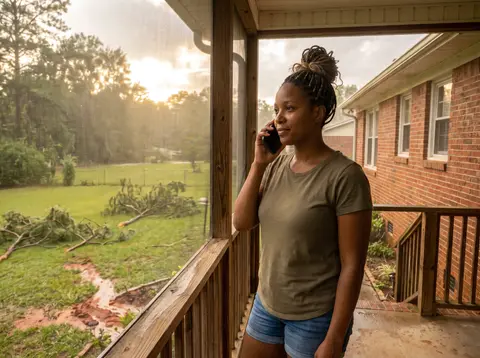
![A woman on a screened back porch talks on the phone after a summer storm, broken pine branches on the wet lawn.]() 1
You call
Tell them what happened and where. Have the address ready.
- 2
We connect you
A call network puts you through to an independent local restoration company that serves Gainesville and is taking calls.
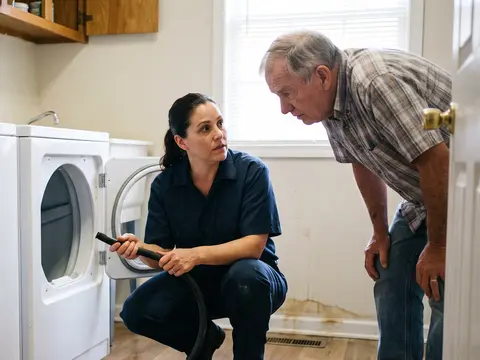
![A technician crouches by a washing machine and shows the homeowner its supply hose, a water stain along the wall behind.]() 3
They assess and quote
If you want a visit, they look at the damage and quote their own price. Ask for it in writing.
We are a free referral service, not a contractor. The company that answers sets its own prices. How this service works
Want a local company to look at it?
Free to call. An independent restoration company that serves Gainesville answers, and you decide what happens next.
Call (770) 536-9258Gainesville Water Damage Advice is a free referral and information service, not a contractor. Calls go through our call-tracking line to independent local restoration companies, and we may be paid when a call qualifies. We do not do the work and do not set prices or availability. How it works
Sources
Each numbered note on this page points here. We read every page on October 24, 2026. Where sources disagree we say so; where we could not find a source we left the claim out. We are not affiliated with any of these organizations.
- U.S. EPA, A Brief Guide to Mold, Moisture and Your Home. Page updated February 18, 2026. www.epa.gov/mold/brief-guide-mold-moisture-and-your-home
- Triple-I (Insurance Information Institute), Settling insurance claims after a disaster. No date shown (page copyright 2026). www.iii.org/article/settling-insurance-claims-after-a-disaster
- Triple-I (Insurance Information Institute), How to protect your home from water damage. No date shown (page copyright 2026). www.iii.org/article/how-to-protect-your-home-from-water-damage
- CDC, Safety Guidelines: Reentering Your Flooded Home. Page updated August 24, 2026. www.cdc.gov/floods/safety/reentering-your-flooded-home-safety.html
- National Weather Service (NOAA), Turn Around Don't Drown. Undated page, read October 24, 2026. www.weather.gov/safety/flood-turn-around-dont-drown
- Cleanfax (trade magazine), Jeff Cross, "Understanding Water Damage Categories". May 6, 2025. cleanfax.com/water-damage-categories/ Summarises the IICRC S500 categories. We have not reproduced the S500 standard itself, which is sold by IICRC.
- IICRC, ANSI/IICRC S500 Consensus Body Issues Position Statement on Category of Water Damage and Weather-Related Events (press release). March 16, 2026. iicrc.org/wp-content/uploads/2026/04/Weather-Related-Water-Damage-Position-PR_March-2026.p…